

Taro Shirakawa, M.D., Ph.D.
After graduating from the Faculty of Medicine at Kyoto University, he carried out extensive research at the University of Oxford and Osaka University.
After serving in positions including Lecturer in Respiratory Medicine at the University of Oxford Medical School; Associate Professor in the Department of Experimental Medicine, Graduate School of the University of Wales College of Medicine; Visiting Professor of Respiratory Medicine at Xijing Hospital, affiliated with the Fourth Military Medical University in China; and Visiting Professor in the Department of Molecular Allergology at the International Nasal Allergy Center of Nanjing Medical University, he became a Professor at the Kyoto University Graduate School of Medicine in 2000.
From 2001 he concurrently served as (part-time) Team Leader of the Allergy Constitution-Related Gene Research Team at the RIKEN SNP Research Center, among other roles, and in 2008 he opened a clinic focusing mainly on integrative medicine and became its director. Since 2018 he has also served as a cancer treatment specialist at Tenyukai's "Nozomi Clinic," where he remains actively engaged.
Cancer is not something to fear
Dr. Taro Shirakawa, a well-known specialist in the treatment of terminal cancer in Japan, has attracted attention for his comprehensive therapy using "iodine water."
With this therapy, whereas the average 3-year survival rate for terminal cancer patients worldwide is 15%, the 3-year survival rate of patients treated by Dr. Shirakawa has risen to as high as 60%.
This result is regarded as a major achievement that gives hope to patients with terminal cancer. To date, the number of patients who have received comprehensive treatment using iodine water has reached 300 or more.


HOPE HIKARI (iodine water)
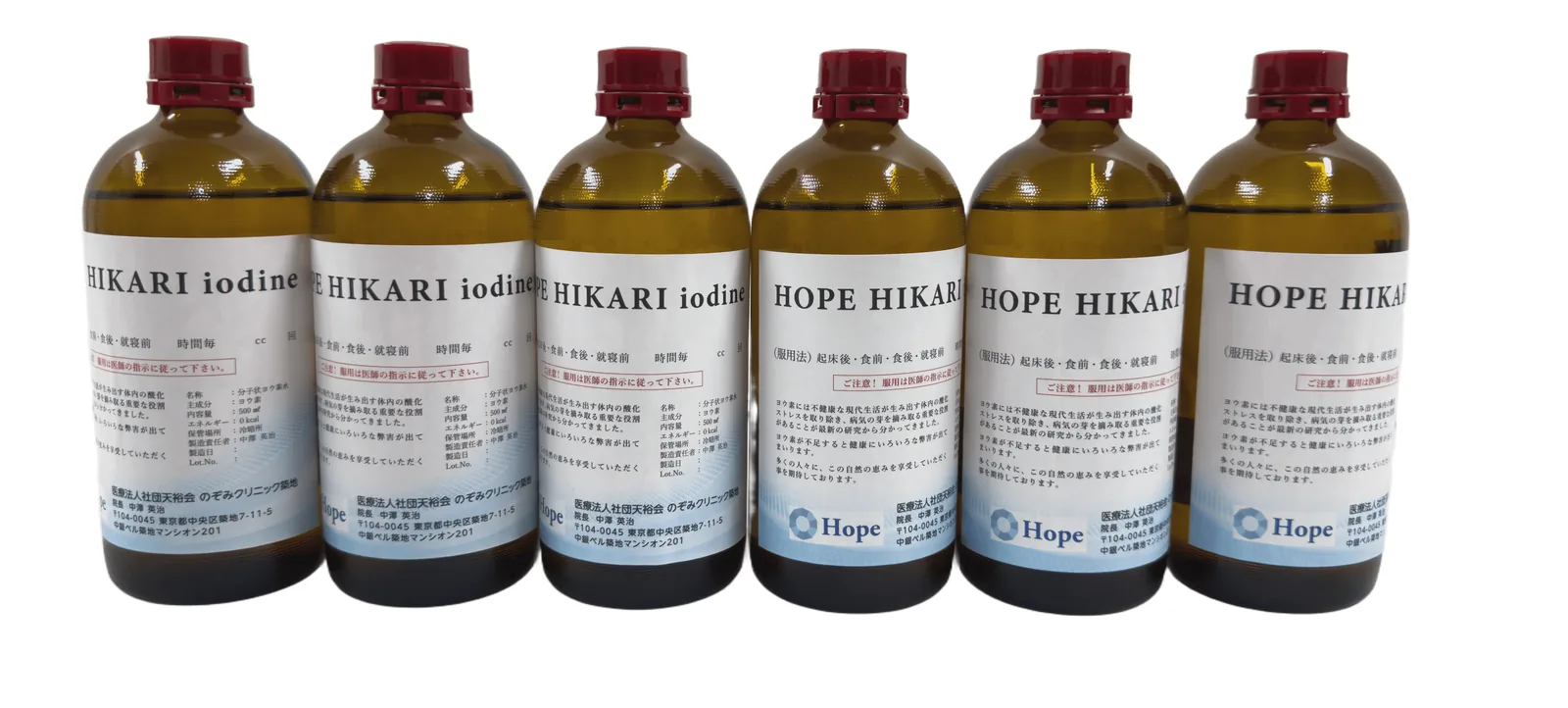
About HOPE HIKARI (iodine water)
"HOPE HIKARI" is an iodine water based on joint research and development by Dr. Taro Shirakawa and Yuaina Co., Ltd., and it is expected to have special effects in cancer treatment.
The anticancer mechanism of HOPE HIKARI

1. Direct action: Uses the strong redox properties of iodine to induce mitochondria-mediated apoptosis.
- Disruption of the mitochondrial membrane potential: When iodine enters a cell, it releases electrons (e-) and acts by disrupting the mitochondrial membrane potential of cancer cells. A drop in the mitochondrial membrane potential is an important step in cell apoptosis. When the mitochondrial membrane potential drops, the mitochondria release pro-apoptotic factors, which activate the caspase pathway and ultimately cause apoptosis of the cancer cells.
- Antioxidant action: The antioxidant action of iodine helps remove the excess reactive oxygen produced by cancer cells and improve inflammation in the local microenvironment. It also protects normal cells from oxidative stress while at the same time promoting the entry of cancer cells into apoptosis.
2. Indirect action: Regulation of nuclear signaling pathways
- Formation of 6-iodolactone (6-IL): Iodine reacts with arachidonic acid, a membrane lipid, to form 6-iodolactone (6-IL). This is a compound with antitumor activity. 6-IL can induce the expression of the tumor suppressor genes p53 and p21; these genes are involved in regulating the cell cycle and induce the arrest of cell division and cell apoptosis. Even more importantly, 6-IL binds to PPARγ (peroxisome proliferator-activated receptor gamma) and activates its function.
- Activation of PPARγ: PPARγ is a nuclear receptor that plays a very important role in cell metabolism, differentiation and apoptosis. Activated PPARγ not only suppresses cell differentiation and proliferation and promotes cell apoptosis, but can also block the epithelial-mesenchymal transition (EMT) of cancer.
Explanation: Epithelial-mesenchymal transition (EMT) is an important process through which cancer cells acquire invasiveness and the ability to metastasize. EMT not only enables cancer cells to move from the primary tumor site and invade other tissues, but also gives them various capabilities and increases their resistance to treatment.
3. Specificity: Selective toxicity to cancer cells
- Low toxicity to normal cells: Because cancer cells contain arachidonic acid at higher concentrations than normal cells, the potent anticancer activity of iodine is exerted by reacting with the membrane lipid arachidonic acid to form 6-IL and activating the function of PPARγ.
For this reason, iodine water is highly selective: it blocks EMT (epithelial-mesenchymal transition) in tumor cells and induces apoptosis (cell death) of cancer cells, while not damaging normal cells. Iodine is also one of the important elements in the metabolism of the human body, and a stable intake of iodine has been shown to be safe and effective. Because of this broad applicability, iodine is attracting attention as a very promising anticancer agent.

HOPE HIKARI (iodine water) is a drug not approved in Japan: it has not received approval under Japan's Pharmaceuticals and Medical Devices Act.
Under Japan's Pharmaceutical Affairs Law, for a general drug to be distributed on the market, it must obtain drug approval and undergo large-scale pharmacological testing before it can be sold.
However, when a drug is not distributed on the market and is used only for treatment or research purposes at specific hospitals, it is not subject to the restrictions of the Pharmaceutical Affairs Law. A hospital with medical qualifications need only report the drug's raw materials, manufacturing instructions, uses, treatment method and safety to the Ministry of Health and Welfare or the public health center. Each manufacturing lot must be inspected by a designated institution, and only if it passes can it be prescribed in-house or used for patients. In addition, information such as the names and contact details of the people it is used for must be reported to the public health center once a month. Responsibility for the quality of the drug lies with the hospital that uses it and that hospital's attending physician. The Ministry of Health and Welfare and the public health center are responsible for supervision and guidance.
Currently, HOPE HIKARI (iodine water) is attracting the attention of many patients as a rising star among anticancer agents, owing to its high efficacy, few side effects and high tolerability. Japan's unique medical and drug manufacturing systems ensure the safety of drugs and active development of new drugs.
Fees (self-pay)
| Category | Details | Fee |
|---|---|---|
| Consultation | Cancer Care (Self-pay), first/follow-up visit Second opinion with Dr. Shirakawa, first/follow-up visit | Please contact us |
| Tests | CTC test (recommended by Dr. Shirakawa)Fasting blood draw; results in about 1 week | |
| Prescription(1 month supply) | HOPE HIKARI (iodine water): 6 bottles | |
| 11-1 lactic acid bacteria: 6 boxes | ||
| High-concentration hydrogen capsules: 3 bottles | ||
| Seaweed AIF: 1 bottle | ||
| Seaweed DF: 3 bottles |
* This is self-pay treatment (not covered by health insurance). All visits are by advance appointment only. Please contact us for fees (including fees for patients from overseas).